One of the first metrics every Amazon seller learns is break-even ACOS. It’s a simple concept: the maximum percentage of revenue you can spend on advertising before your profit reaches zero. Most guides explain how to calculate it, and many sellers dutifully add the number to a spreadsheet or use it as the benchmark for every PPC decision they make.
The problem isn’t the calculation.
The problem is believing that once you’ve calculated your break-even ACOS, you’ve found a permanent answer.
In reality, you’ve only described your business at a specific moment in time.
Break-even ACOS Is Not an Advertising Metric
We often talk about break-even ACOS as though it belongs exclusively to PPC. After all, it’s used to decide whether campaigns should be scaled, optimized, or paused.
But break-even ACOS doesn’t actually originate in advertising.
It originates in economics.
At its core, break-even ACOS answers a simple business question:
How much can I afford to spend to acquire a customer before the sale stops being profitable?
Advertising merely consumes that budget. It doesn’t determine it.
The budget is determined by everything else happening in your business: your product costs, Amazon fees, pricing strategy, return rates, discounts, taxes, shipping costs, and dozens of other variables that together define the profitability of every order.
This distinction is subtle, but it fundamentally changes how you should think about advertising performance.
Every Click Enters a Business System
Imagine two sellers running identical PPC campaigns.
They sell the same product at the same price.
Their campaigns generate the same impressions, clicks, conversions, and ACOS.
On paper, their advertising performance is identical.
Yet one seller earns significantly more profit than the other.
Why?
Because advertising doesn’t operate in isolation.
Every click enters a much larger business system.
One seller may have negotiated lower manufacturing costs. The other may experience a higher return rate. One benefits from lower storage costs, while the other frequently runs coupons that reduce the effective selling price. Perhaps one has optimized packaging to reduce damage during shipping, while the other loses inventory to unsellable returns.
The campaigns are the same.
The businesses are not.
Which means the value of every advertising click is different.
This is why there is no universal “good ACOS.” More importantly, there is no universal break-even ACOS—not even for a single product.
Why Yesterday’s Break-even ACOS Can Mislead You
Many sellers think of break-even ACOS as a fixed property of a product, almost like its dimensions or weight.
In reality, it behaves much more like a financial forecast. It remains valid only as long as the assumptions behind it remain true.
Suppose you calculated a break-even ACOS of 34% in January. At the time, your manufacturing costs, Amazon fees, refund rate, and pricing strategy supported that number.
Three months later, several things have changed.
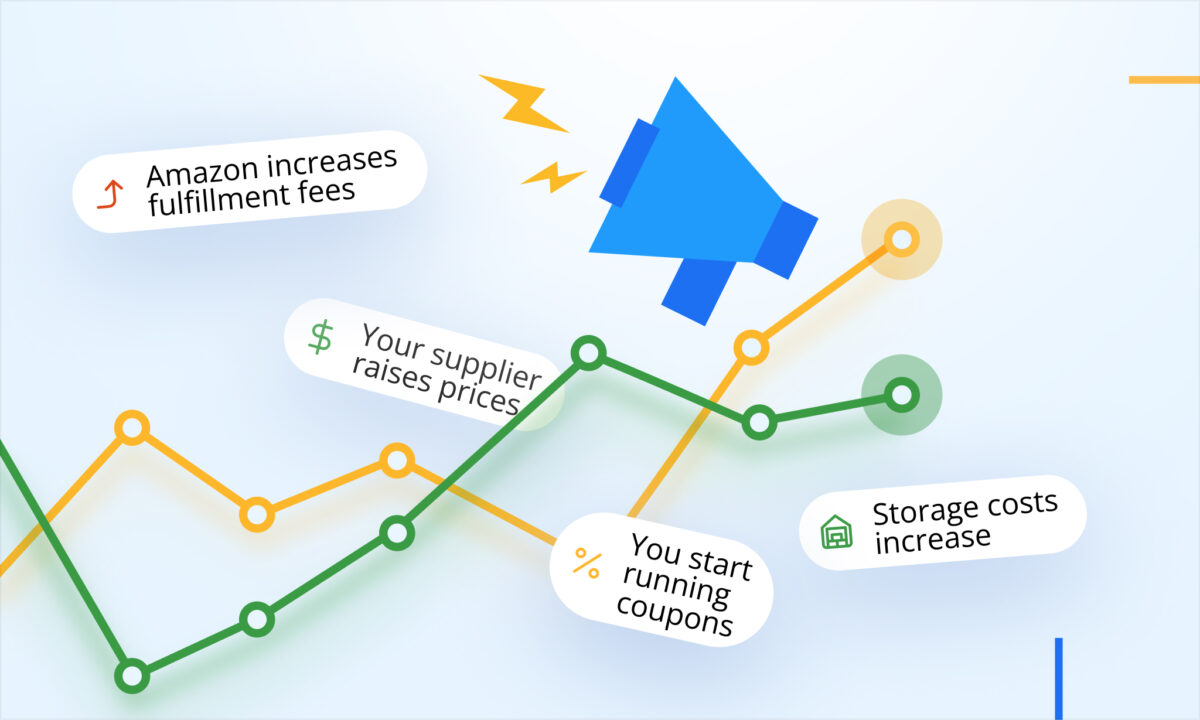
Your supplier increased prices by 8%.
Amazon introduced higher fulfillment fees.
Returns have become more frequent after a change in packaging.
You’ve started running coupons to stay competitive.
Your campaigns still report a healthy 29% ACOS, so nothing appears to be wrong.
Yet your margins have quietly deteriorated to the point where your true break-even ACOS is now closer to 26%.
Nothing changed in advertising.
The economics behind the advertising changed.
This is where many sellers make costly decisions. They trust a number that was perfectly accurate when they calculated it, without realizing that the business it described no longer exists.
The Danger of Optimizing the Wrong Problem
When profitability declines, advertising is often the first suspect.
Campaigns are paused.
Budgets are reduced.
Keywords are cut.
Sometimes those are the right decisions.
But just as often, they’re reactions to symptoms rather than causes.
If profitability falls because your COGS increased, lowering bids won’t restore your margins.
If refund rates are climbing because of a quality issue, optimizing search terms won’t solve the problem.
If a coupon campaign is reducing your effective selling price, the problem isn’t necessarily that advertising has become less efficient—it’s that every sale has become less profitable.
Looking at ACOS without looking at the business behind it is like judging a company’s health from its marketing budget alone. You may notice something has changed, but you won’t know why.
The most effective Amazon sellers don’t optimize advertising in isolation. They optimize the business that advertising supports.
This Is Why Static Break-even ACOS Calculations Fall Short
The internet is full of break-even ACOS calculators, and they all perform the same function. They take today’s numbers and produce today’s answer.
There’s nothing inherently wrong with that.
The limitation is that the answer starts becoming outdated the moment those inputs change.
For businesses operating on Amazon, those inputs change constantly.
Costs evolve.
Fees change.
Inventory ages.
Returns fluctuate.
Promotions begin and end.
Margins shift.
Treating break-even ACOS as a fixed benchmark creates an illusion of precision. You may know your break-even ACOS to one decimal place, but that precision becomes meaningless if the underlying assumptions are weeks or months out of date.
How sellerboard Keeps Break-even ACOS Grounded in Reality
This is where sellerboard changes the conversation.
Rather than treating advertising as a standalone discipline, sellerboard connects it to the financial reality of your business. As profitability changes, sellerboard continuously reflects those changes through the data that actually determines whether your advertising remains profitable.
Your Profit Dashboard incorporates the factors that influence your real margins, including updated COGS, Amazon fees, refunds, storage costs, VAT, shipping expenses, reimbursements, coupons, and other operating costs. Instead of comparing your campaigns against a break-even ACOS calculated months ago, you evaluate them against your current business economics.
This also changes the questions you ask.
Instead of wondering whether a 28% ACOS is “good,” you can investigate why profitability declined even though ACOS remained stable. You can identify whether rising return rates, increasing costs, or pricing changes are reducing margins before concluding that your PPC strategy needs to change.
In other words, sellerboard helps you evaluate advertising in context rather than in isolation.
Rethinking What Break-even ACOS Really Means
Perhaps the biggest misconception about break-even ACOS is that sellers think they’re trying to find the right number.
They’re not.
They’re trying to understand how much they can afford to pay for growth.
That answer doesn’t live inside your PPC campaigns.
It emerges from the economics of your entire business.
As those economics evolve, so does your break-even ACOS.
The sellers who consistently make better advertising decisions understand this. They don’t treat break-even ACOS as a constant to memorize, but as a living metric that reflects the current state of their business. By continuously aligning advertising decisions with real profitability instead of outdated assumptions, they avoid optimizing the wrong metrics and focus on what ultimately matters: sustainable, profitable growth.